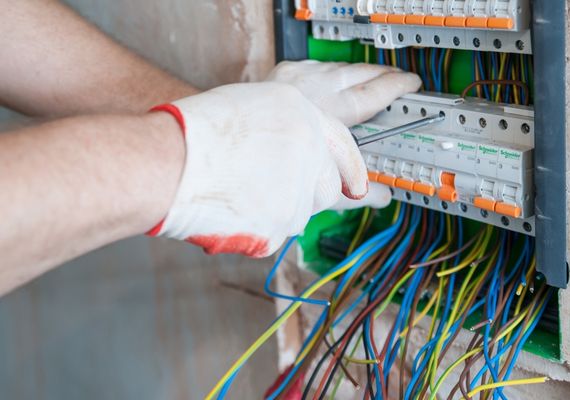
Electrical safety is critical. If you are a landlord or commercial property owner, you are responsible for the safety of electrical systems and, in some cases, appliances that may be used by your tenants, employees and customers.
In the UK, many properties (including all rental accommodations and many commercial business premises) require regular electrical inspections. These need to be carried out at least every 5 years, and so the process is commonly known as ‘5-year electrical testing’. It is also known as Periodic Inspection or EICR (Electrical Installation Condition Report), which is the main testing report produced during the process.
Here we will look at the legal context, who needs to carry out testing, what’s involved, the costs and benefits, and how Peninsula Electrical can support the process.
What Is 5-Year or Periodic Electrical Testing?
5-year testing refers to periodic electrical inspection, UK rules that require relevant properties to be tested at least every 5 years. The formal name for this is Periodic Inspection and Testing, and it most often results in an EICR (Electrical Installation Condition Report).
The purpose of this is to check that all wiring, sockets, fuse boxes, circuits and earthing/bonding systems are safe.
It involves a full inspection and covers a number of key elements, including:
- Fixed Wiring and Infrastructure: The main electrical circuits, cables, and wiring throughout the property.
- Consumer Unit: Also known as a fuse box or distribution board, including protective devices like RCDs (Residual Current Devices) and MCBs (mini circuit breakers).
- Sockets and switches: All sockets, switches and similar fixed accessories.
- Lighting circuits: All lighting circuits throughout the property.
- Some fixed accessories: Such as immersion heaters or extractor fans. Portable appliances like fridges, computers and kettles are not generally part of 5-year testing but may be covered under separate PAT (Portable Appliance Testing) tests.
While every 5 years is standard, some circumstances, such as the age of wiring, building use and any previous issues, may require more frequent checks.
Who Needs a 5-Year Electrical Inspection?
The government says that all rental properties in the UK must now have the electrical installations in their properties inspected and tested by a qualified person at least every 5 years. They must also obtain a report from the qualified person and provide a copy of this to their tenants and to the local council if requested. The rules were changed in 2025 to apply the rules to both private and social landlords.
In general, this means engaging a qualified person or company like Peninsula Electrical and obtaining an EICR every 5 years.
The rules are not quite as clear-cut for commercial properties. Property and business owners are obliged to ensure the safety of people in their buildings and to maintain electrical equipment as covered by legislation including the Health and Safety at Work Act 1974 and the Electricity at Work Regulations 1989. This may not necessarily require an EICR but the report can play an important role in the process, particularly in demonstrating that all relevant checks have been carried out. The requirements can also vary depending on the type of business and building involved.
Other parties that may be interested in 5-year electrical testing may include:
- Private homeowners: getting an EICR is not a requirement, but may be advisable for peace of mind and safety, especially in older homes.
- Tenants and end-users: Although landlords are required to get the checks carried out, tenants should encourage landlords or property owners to maintain compliance if this is not done.
- People with rental properties, older properties or premises with high usage may wish to get testing done more regularly than 5-year intervals.
What Happens During the 5-Year Test?
When carrying out a house electrical inspection (or other relevant building), there are a number of steps to be carried out, including
- Visual inspection of infrastructure, including wiring, sockets and switchgear.
- Functional testing, such as RCD tests, circuit checks, polarity, earthing, and insulation resistance, is conducted to ensure everything is working as it should.
- Testing of fixed lighting, relevant hard-wired appliances and the consumer unit or fuse board.
- Identification of potential hazards such as worn insulation, overloaded circuits and faulty sockets.
- Generation of an EICR certificate listing satisfactory conditions or required remedial works.
If faults are found, remedial work must be carried out to get the concerned elements up to spec. A re-inspection can then be carried out and a written report provided for compliance and documentation purposes.
Cost and Time: What to Expect
There are many different factors that can affect the time it takes to carry out 5-year electrical testing, as well as the overall costs involved. A standard 3–4 bedroom house might take a few hours, for example. An individual flat or small unit could take less, while a block of flats or communal building may take longer.
Costs can also be affected by the complexity and age of the systems and infrastructure. We can provide an upfront quote and it’s also worth remembering that the costs are a small investment compared with potential risks such as fire and electric shock. For landlords or businesses compliance can also affect insurance, tenant safety and may be a legal requirement.
Risks of Skipping Regular Electrical Tests
Hidden wiring faults can lead to fires and electric shocks. These can pose safety risks, especially in older houses. Insurance claims could be voided if there are no regular inspection records, and some insurers may require them before providing cover, especially for commercial premises.
Landlord electrical safety UK rules also require regular testing, and a financial penalty of up to £40,000 can be imposed on landlords who are in breach of specified duties under the regulations.
Skipping testing could also lead to higher repair costs in the future, as some issues may be caught that could deteriorate or cause further damage along the line.
 info@peninsulaelectrical.com
 0151 668 0794